FULL-STACK CAPSTONE / TEAM PROJECT / 2026
GradNavi: designing and delivering an AI-powered career platform.
A career guidance application helping students explore career paths, understand skill gaps, prepare job applications and practise interviews.
I led substantial design, full-stack implementation and project delivery work, from the GradNavi visual identity and student experience to career-scoring services, AI integration and quality assurance.
Collaborative product. The sections below distinguish my work from teammates' contributions using GitHub implementation evidence; branding and Figma design ownership is also informed by my first-hand account.
REAL APPLICATION / SCREENSHOTS
The GradNavi experience in action.
Screenshots from GradNavi's application and testing repository. The two student interface previews show demonstration data; the administrator evidence is redacted. The screenshots illustrate delivered team features—not sole authorship of every screen.
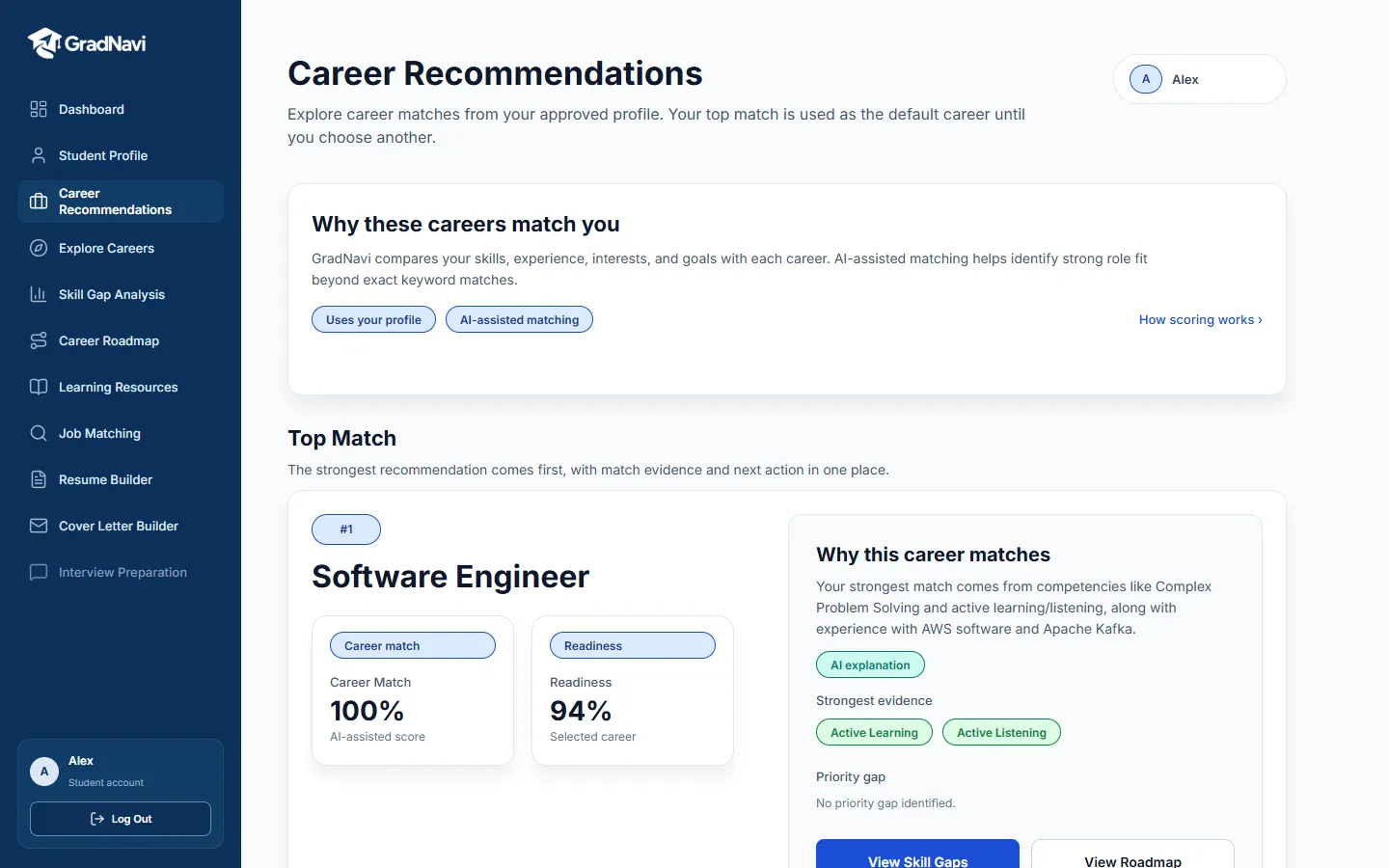
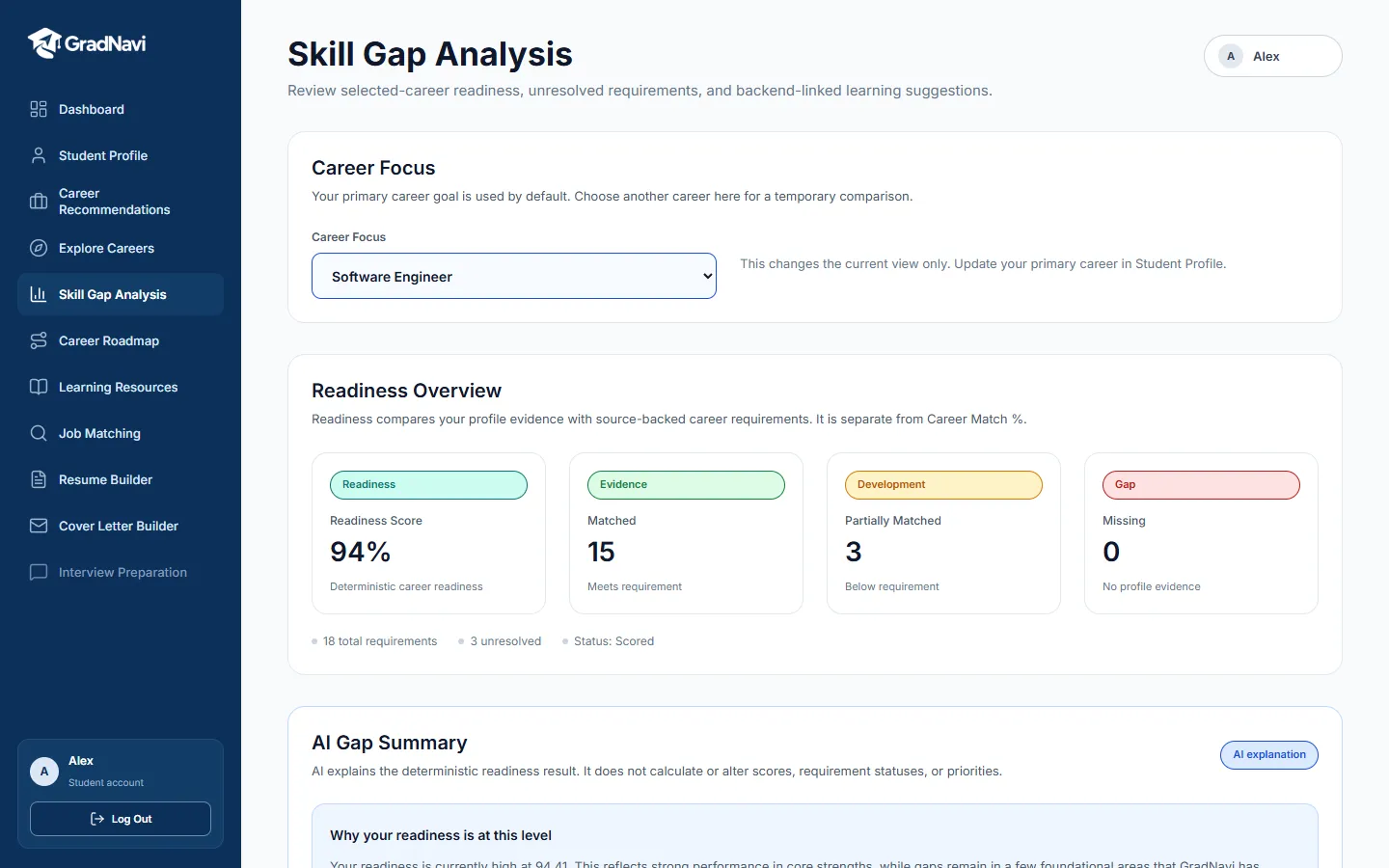
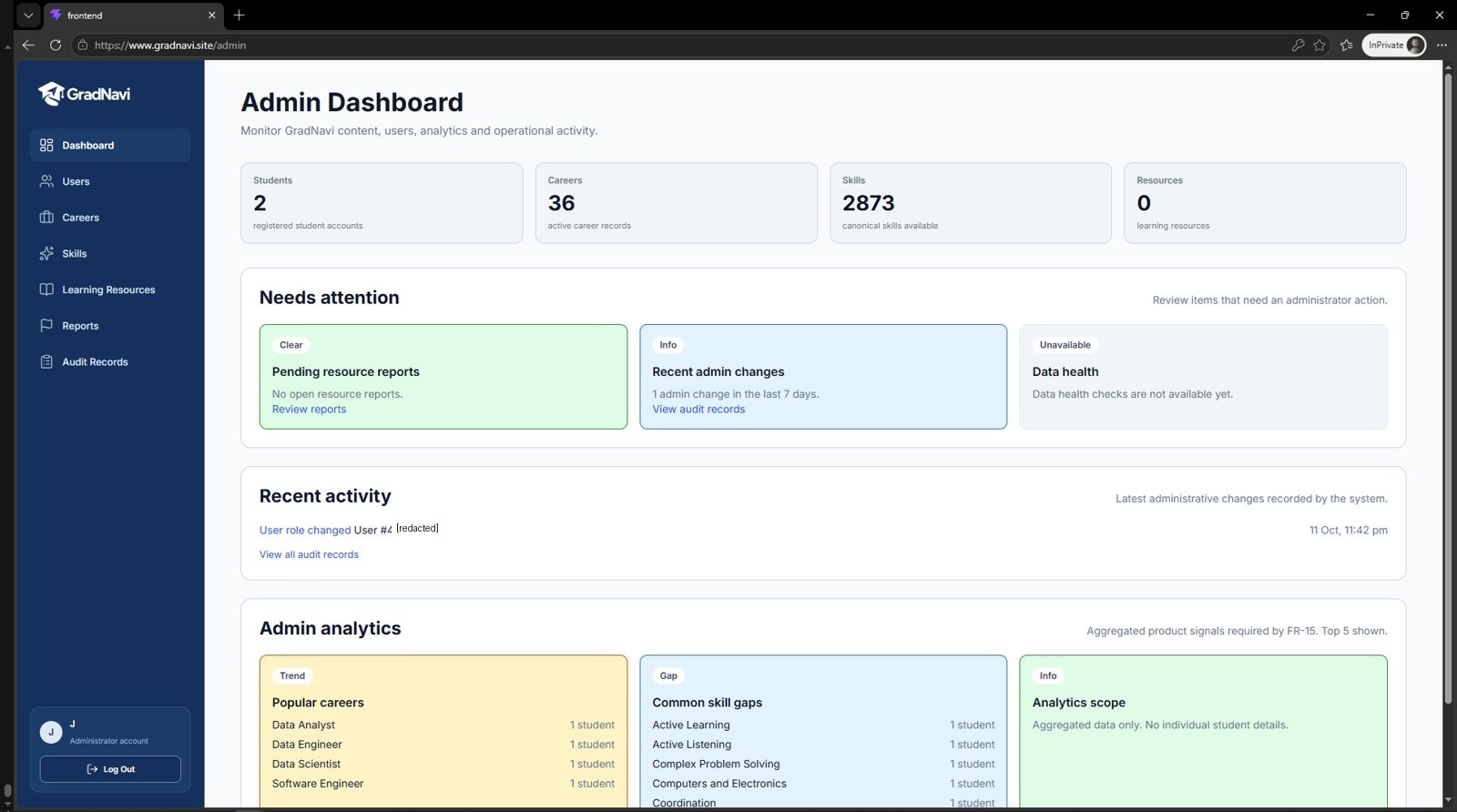
MORE PRODUCT EVIDENCE / SPRINT 5
Explore the delivered application.
Authentic verification screenshots from the public GradNavi repository. Open any preview to inspect the full image; features shown reflect team delivery, not sole authorship.
04 / PUBLIC EXPERIENCE
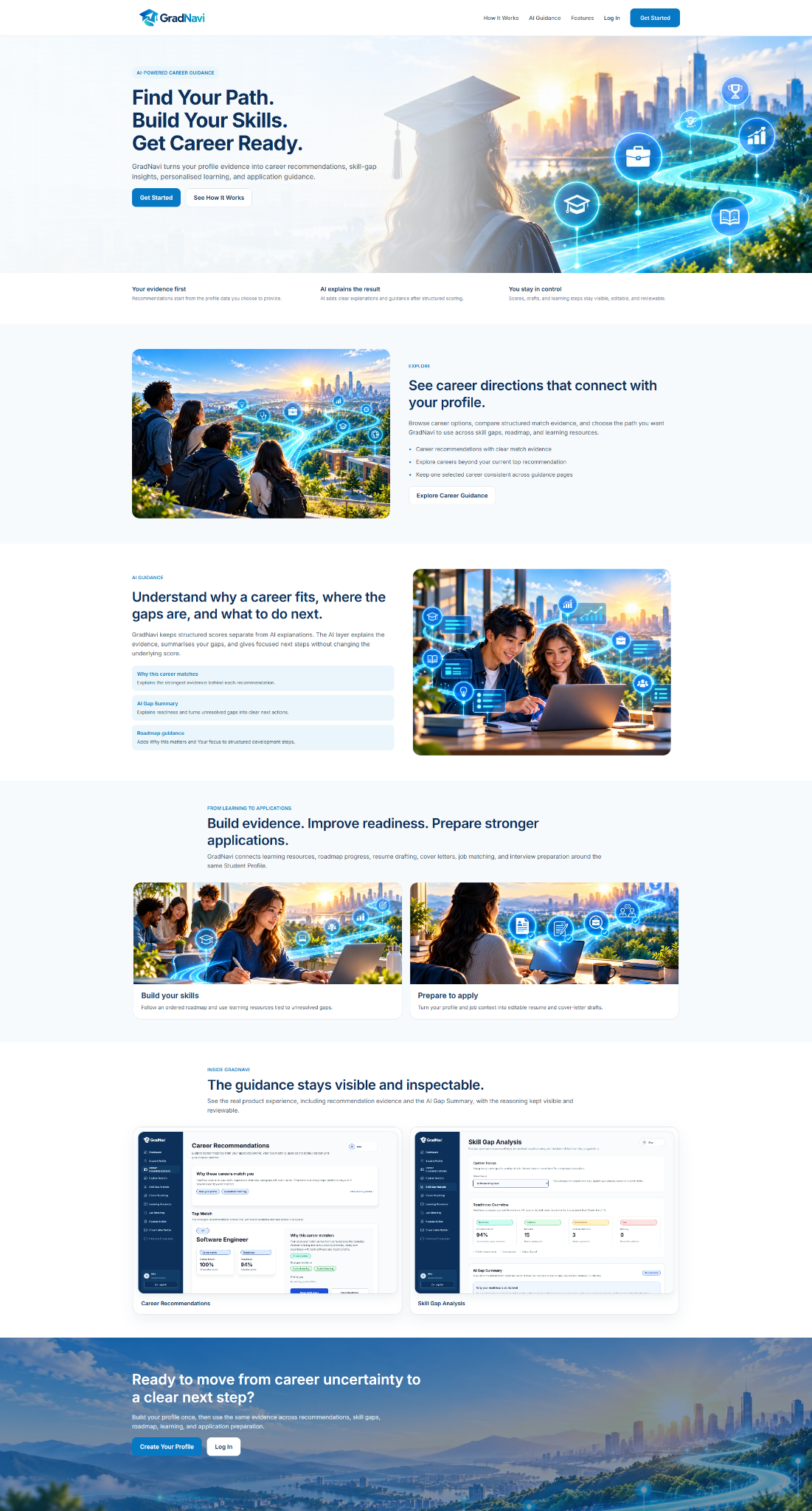
From brand identity to a working homepage.
The landing page translates the GradNavi identity and student career-guidance experience into the deployed application.
View original verification screenshot ↗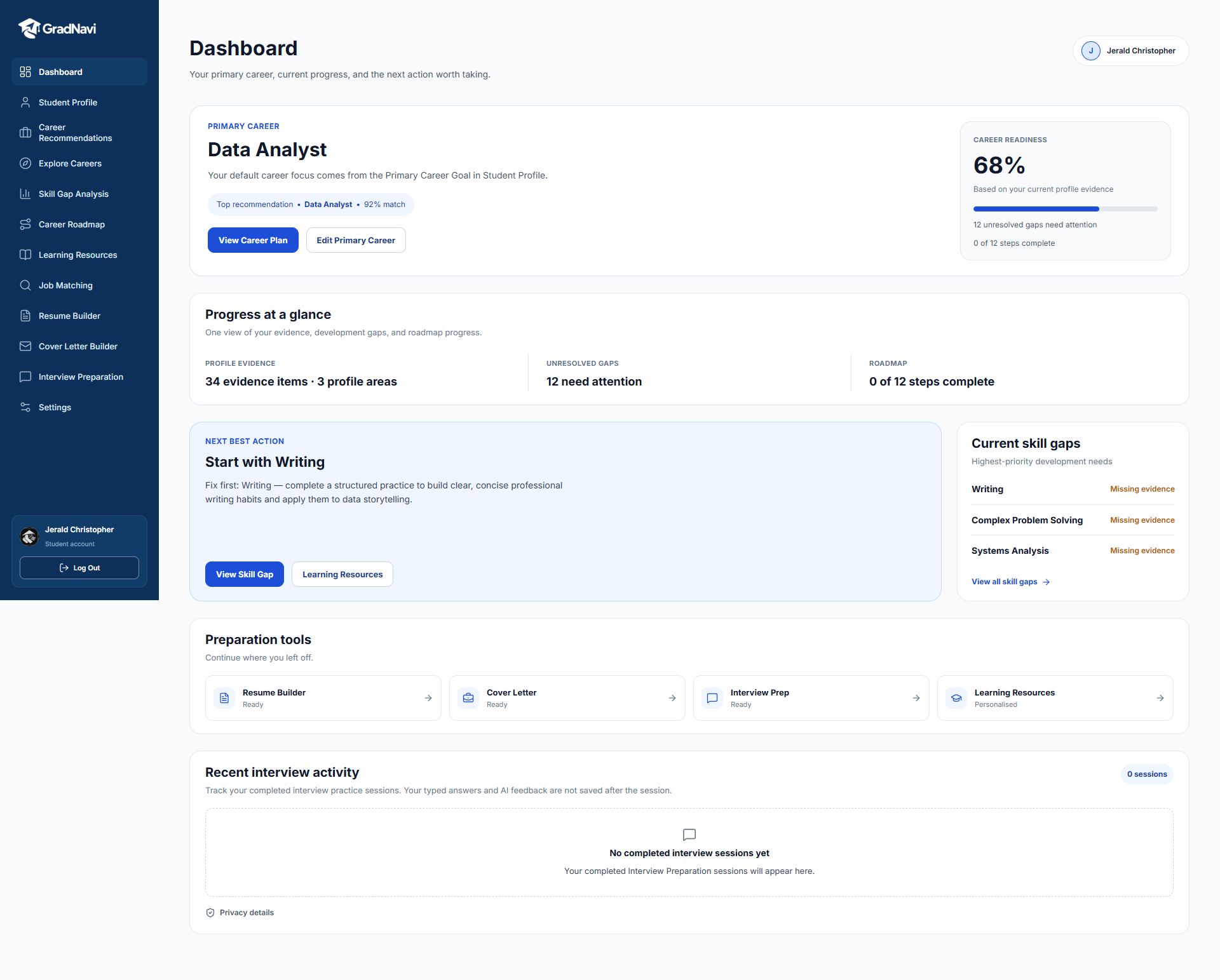
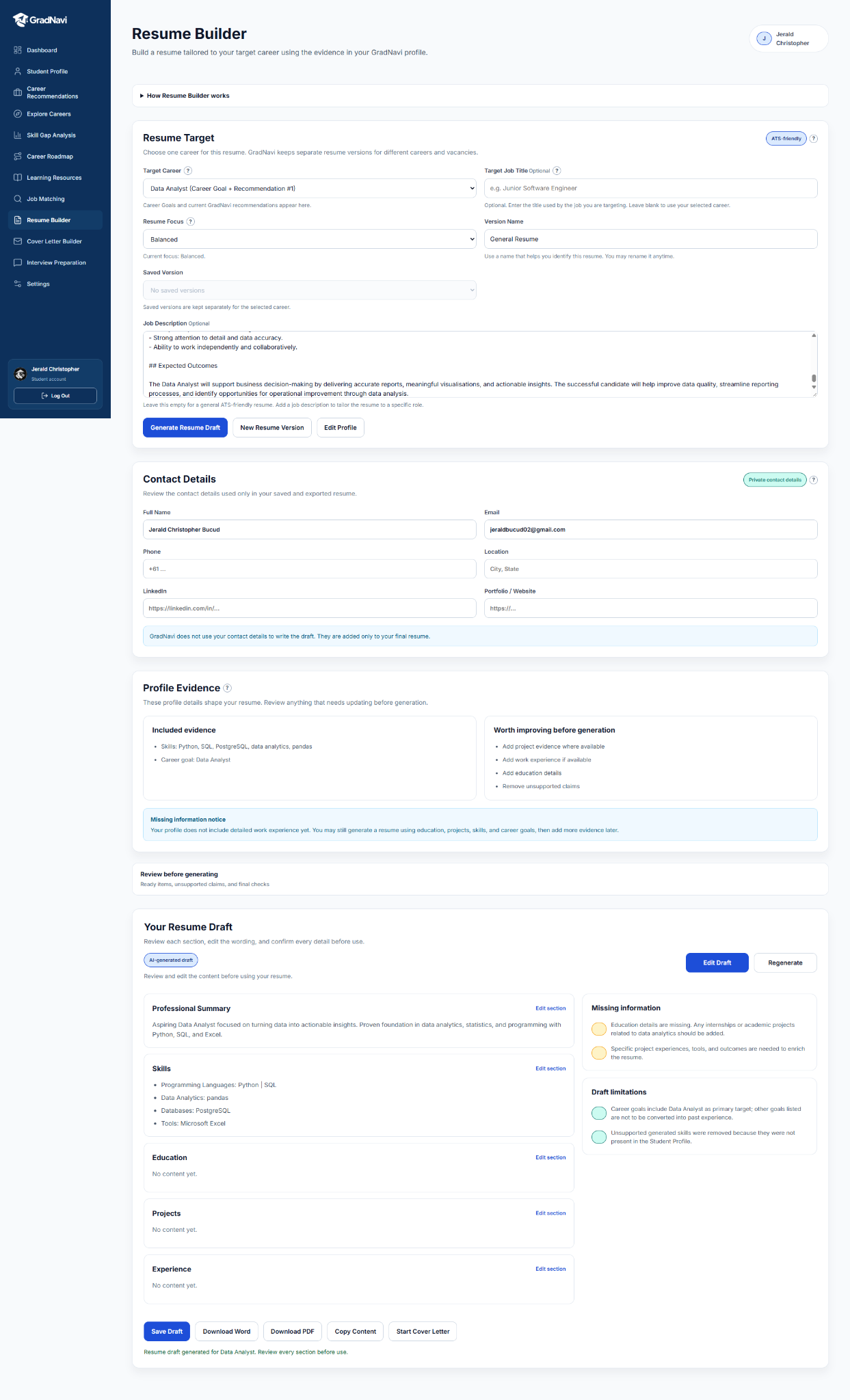
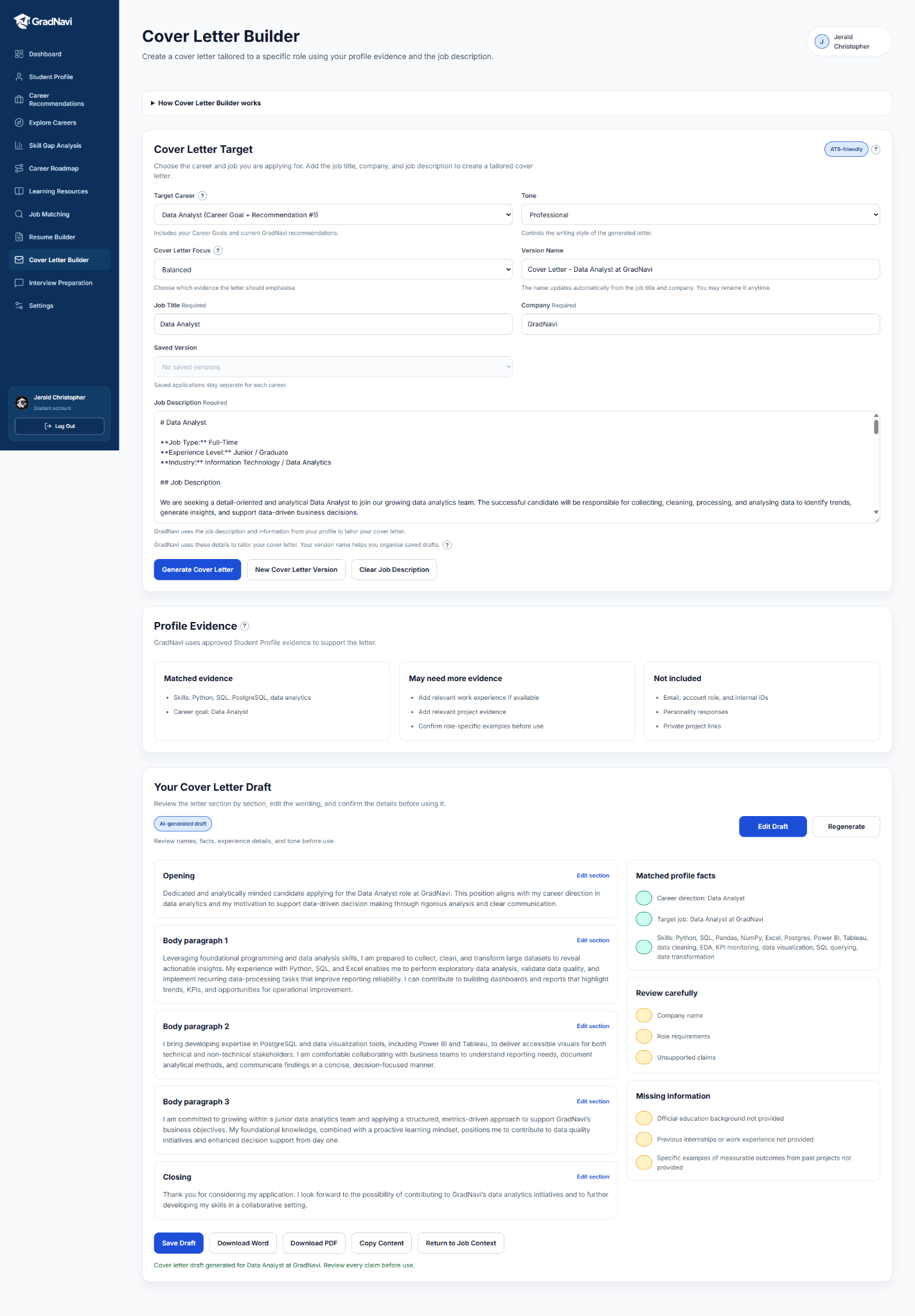
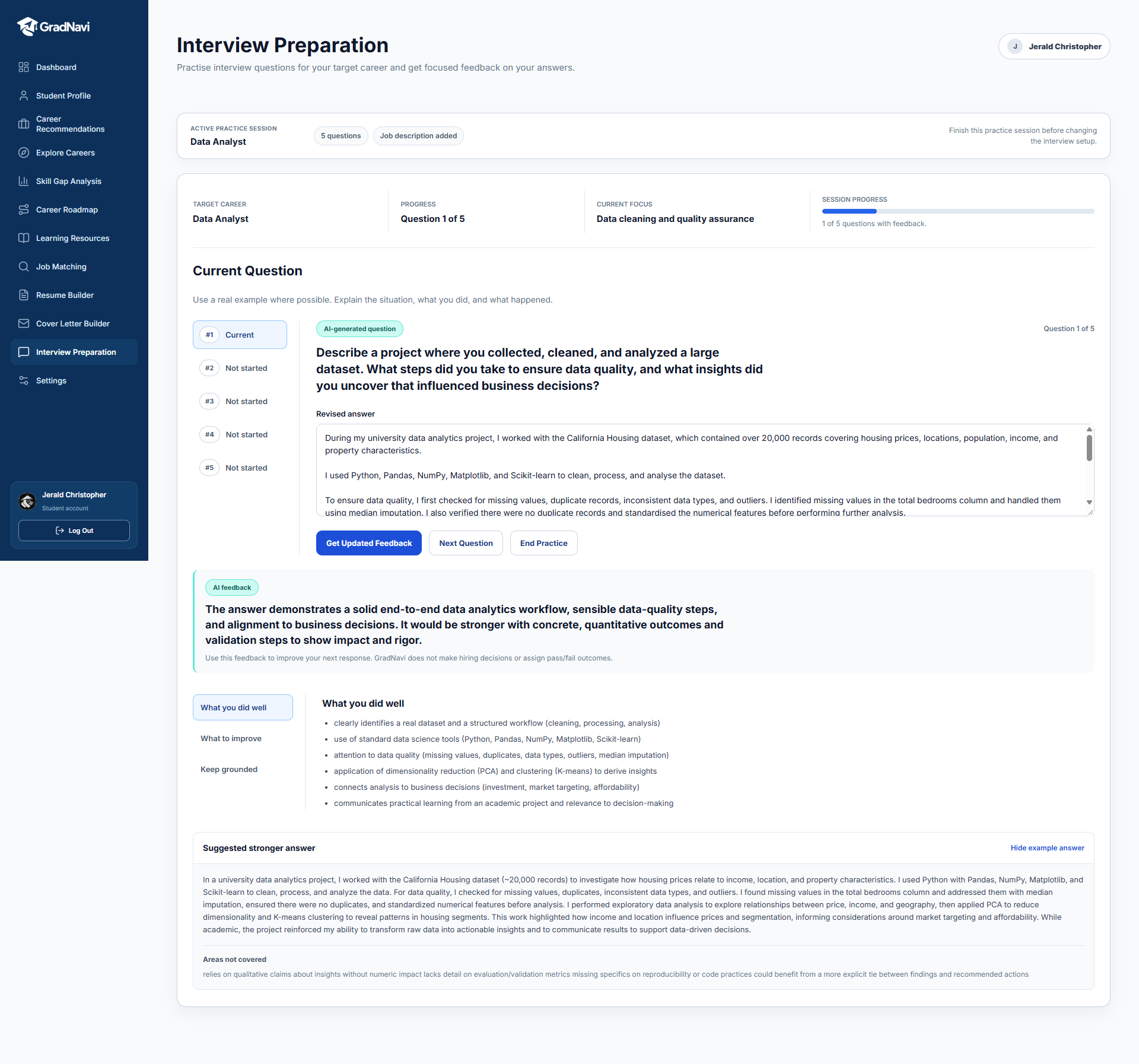
Source: GradNavi repository demo-preview assets and redacted Sprint 5 UAT evidence. No private student records or credentials are reproduced.
01 / PRODUCT DESIGN & IDENTITY
From wireframes and branding to a usable application
I created GradNavi's logo and brand identity and designed the broader low- and high-fidelity experience in Figma, including the student journeys and interface layouts. The visual system informed the public landing page, authentication screens, student navigation and learning/career workflows. This design authorship is my first-hand account; the connected Figma revision history was not independently available for this audit.
Logo and visual identity
Developed the GradNavi identity and design direction carried through the shipped application.
Low- and high-fidelity UI
Created the fuller product wireframes and screen designs in the shared Figma workspace after initial UI exploration.
Design translated into React
Built the homepage foundation and later implemented the global home, authentication and student-shell redesign, with responsive refinements.
The original GradNavi Figma file contains the design source for the branding and application wireframes; its frames are linked, not recreated or substituted with illustrative mockups.
View GradNavi design workspace ↗ · GitHub implementation: #6, #76, #88.
02 / MY IMPLEMENTATION
Full-stack contributions across the student experience and AI services
My implementation work spanned the early frontend foundation, student workflows, supporting Django services, system integration, quality and later redesigns. These examples are tied to actual implementation PRs—not the original WBS task ownership.
Student experience and frontend engineering
- Foundation and onboarding: React/Vite routing, the original Home Page, login/registration and Student Profile interfaces, followed by authentication and profile API integration (#6, #8, #12, #14, #23).
- Career guidance: Career Recommendations, Career Readiness, Skill Gap Analysis, shared career selection, Career Roadmap, Learning Resources and Explore Careers interfaces (#44, #47, #50).
- Application and progress workflows: Resume and Cover Letter Builder interfaces and export/draft flows, Job Matching interface, Student Dashboard, account settings, global homepage/authentication redesign and responsive student-page improvements (#59, #61, #75, #76, #77, #88).
Backend, scoring and AI engineering
- Career intelligence: PostgreSQL configuration, reference data, weighted recommendation logic, readiness/gap services and composite scoring with semantic alignment (#1, #26, #27, #28, #45).
- AI and privacy: structured AI input/output contracts, reusable prompts, privacy allowlist and provider boundary; interview questions/feedback endpoints; external OpenAI provider integration and response validation (#36, #38, #65, #66).
- Service enhancements: learning roadmap/resource backend changes, Explore Careers evaluation API, deterministic job-description matching and additional backend work in the document-builder implementation (#46, #48, #49, #59, #60).
03 / PLANNING, QUALITY & RELEASE
Keeping an evolving capstone deliverable
Beyond feature implementation, I maintained extensive project-management and delivery work: plans and schedules, integration/testing trackers, meeting evidence, sprint reconciliation, defect follow-up and release preparation. My account is that I carried most of the practical coordination work despite the planned rotating-leader schedule. GitHub substantiates substantial documented management contributions; it cannot independently calculate individual effort percentages or every offline follow-up.
Scope and architecture
REST and security architecture, profile data design, Microsoft Project alignment and sprint/backlog planning.
Testing and integration
Test plans, regression evidence, defects, security and permissions, and cross-feature integration.
Release and closeout
Integration checkpoints, staging fixes, milestone reconciliation, production verification and final evidence.
Representative records: API design #2, security architecture #3, schedule #18, meeting evidence #42, Sprint 5 planning #79, release #101 and closeout #103.
04 / COLLABORATIVE DELIVERY
What teammates implemented
Enamul121 — backend services
Enamul authored the authenticated registration/login APIs and student profile models/API (#9, #22), recommendation endpoint and initial learning-roadmap API (#29, #35), resume/cover-letter generation backend services (#37, #40), and administrator services and audit enforcement (#62, #70). Backend/database deployment configuration is recorded in #93.
Joyee8 — early design concepts, administration UI and deployment
Joyee contributed early Figma foundations and selected preliminary screen layouts (#32), and authored the original Interview Preparation interface and question/feedback flow (#63), a substantial administrative interface with protected routes and management screens (#64), and frontend deployment/asset optimisation work (#92, #94, #95).
This distinction matters: the backend and interface components were delivered collaboratively. The original WBS task allocations do not accurately describe every final implementation or the final design authorship; the early Figma concepts are distinct from the broader design work described above.
05 / IMPORTANT IMPLEMENTATION CORRECTION
Interview Preparation: original UI and later integration
Joyee's PR #63 contains the original Interview Preparation page, practice component and API service. That PR was closed without a direct merge. Later, my PR #78 merged the interview workflow with additional session persistence, validation and cross-feature changes. Comparing their added code reveals substantial identical UI and service lines.
The correct attribution is **original Interview Preparation UI: Joyee; subsequent integration, expansion and validation: Jerald**. Being the author of the merged integration PR is not evidence of having independently written all code in it.
06 / VERIFIED ENGINEERING ARCHITECTURE
How the shipped system fits together
The React student and administrator interfaces call Django REST Framework endpoints backed by PostgreSQL. Career and skill reference records support the scored recommendations, readiness and skill-gap services. Document and interview features use a separate AI service layer for structured prompt contracts, privacy-filtered context, provider integration and response validation.
- Deterministic fit and readiness: career and skill rules produce explainable component scores and a weighted combination; semantic embedding alignment contributes a distinct matching signal, rather than treating a text generator as the sole scoring authority. Evidence: #27, #28, #45.
- Generation boundaries: shared input/output contracts, prompts, safety rules and a privacy allowlist were developed before connecting the external text provider. The later OpenAI integration includes error handling and validation. Evidence: #36, #65, #66.
- Collaborative application delivery: Enamul's document-generation backend services (#37, #40) are used by the React resume and cover-letter builder interfaces implemented in Jerald's #59. Joyee's original interview interface (#63) was later integrated and extended in Jerald's #78.
Engineering lesson: keeping scored decision-support logic, AI-generated text and API contracts separate made it easier to validate behaviour, trace changes and coordinate frontend/backend work. Integration PR ownership is not the same as original code authorship.
07 / QUALITY & VALIDATION
What the repository records—and what it does not prove
- Internal UAT
- 11 / 11 cases reported PASS
- Production verification
- 21 / 21 cases reported PASS
- Delivery record
- Sprint 5 merged in PR #101
The repository's 13 October closeout summary attributes these verification outcomes to team execution reported by the project lead. Tests and production checks support the implementation record, but are not independent certification of AI accuracy, security or professional career-advice quality. Formal delivery acceptance was tracked separately, and final evidence reconciliation was noted as ongoing.
Source: GradNavi README and repository evidence and Sprint 5 PR #101.
08 / ENGINEERING OUTCOME
A capstone prototype with documented implementation and validation
- Application
- React + Django REST Framework
- Storage and AI
- PostgreSQL + OpenAI service layer
- Evidence reviewed
- 106 GitHub pull requests
GradNavi's recorded implementation supports student career exploration and guidance workflows, AI-assisted drafts and interview practice, and administrator functions. The team carried out unit, integration, user acceptance and deployment-verification work. This is a student capstone prototype offering decision support, not independently validated professional career advice.
Explore the GradNavi team repository ↗
Attribution in this public case study is grounded in GitHub PRs, merged code and overlapping original implementations; it does not claim that PR author counts represent individual workload or exclusive ownership.